

Four koji condiments that will elevate your everyday cooking — quietly, and for good.
ISSUE 002 - ELEVATE EVERYTHING: No special equipment. No complicated techniques. Just a jar, a little patience, and the pleasure of watching something slowly come alive.

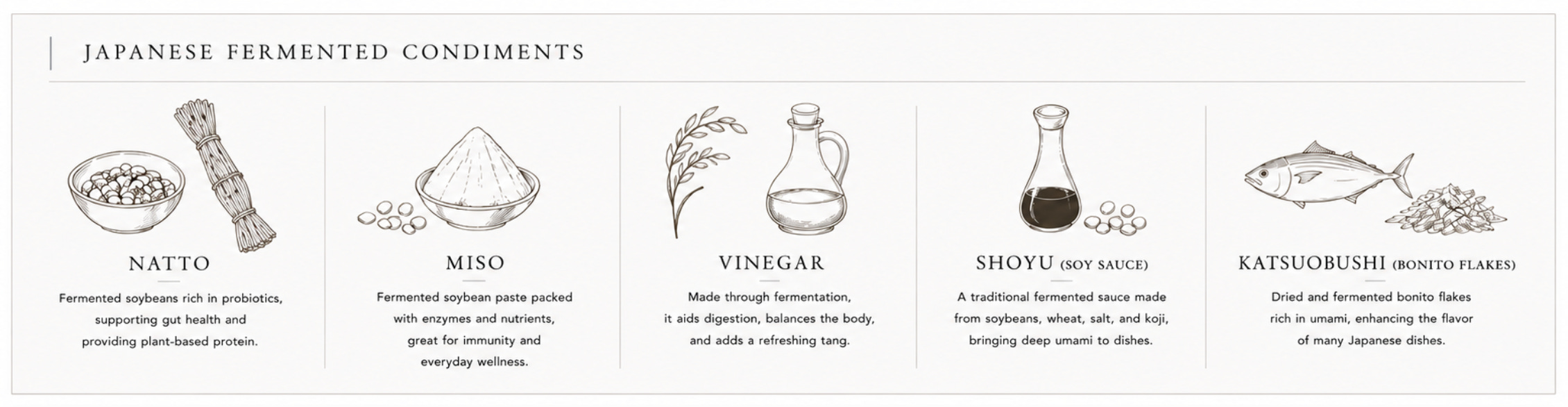
You've seen the word fermentation everywhere lately. In the kitchens of Michelin-starred restaurants, on the pages of wellness magazines, in the titles of cookbooks by chefs who have recently discovered kimchi. And that's fine. Attention is good.
But here’s what I wonder to myself whenever I see it: this has always been “ours”.
In the world of gastronomy, Japanese fermentation is having a quiet revolution. “Umami” rolls off the tongues of chefs on cooking shows around the world — no translation needed. “Koji” appears on menus in cities that have never seen a rice field. The world is waking up. And as a Japanese person, I feel something close to pride.
Because Japanese fermentation never needed a trend. It simply existed — practically, without ceremony — in home kitchens across the country for centuries. Not just Japan, either. Fermentation lives in every corner of the world — sauerkraut in Germany, kimchi in Korea, yogurt and cheese across continents. And in Japanese kitchens: miso in the crock, koji always close at hand, amazake on cold winter mornings, shio koji with records reaching back to the Edo period. These were never superfoods. They were simply food that knew what it was doing.
"What the modern world calls 'gut health,' Japanese home cooks have always called a meal."
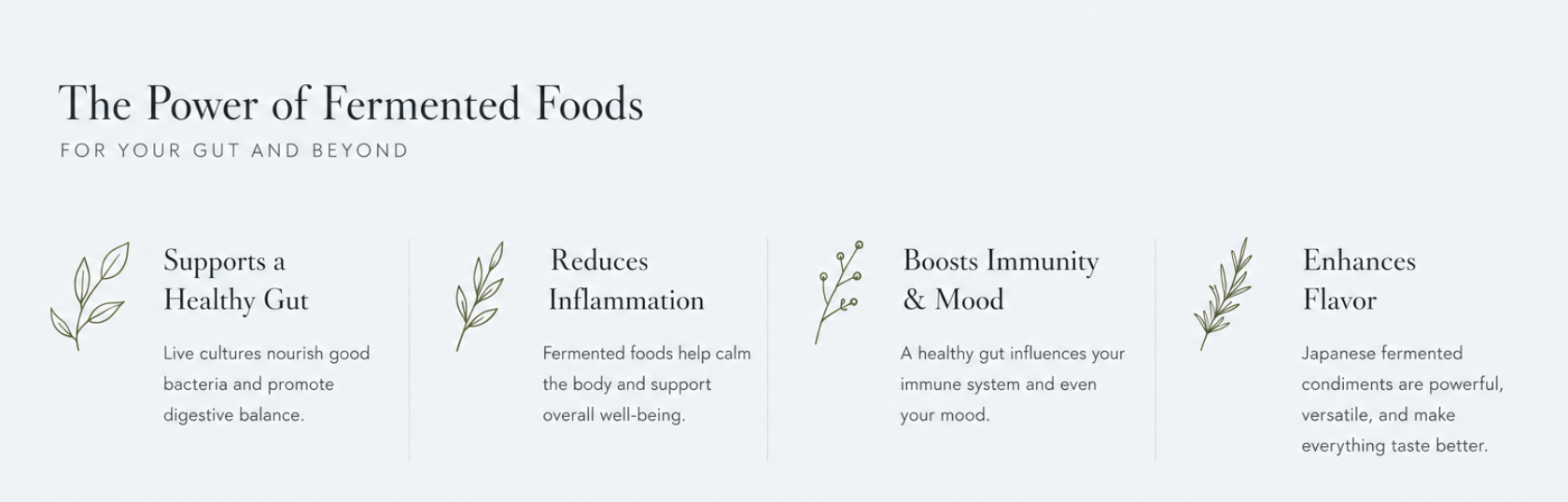
Science is slowly catching up to what Japanese kitchens have long known. A growing body of research links fermented foods to better digestion, lower inflammation, even immunity and mood. Japanese fermented condiments sit close to the center of it.
And they happen to make everything taste better.
I don’t want this moment to be just another trend. Because here’s what I’ve found: the more you learn about koji, the more you use it — the more it becomes something you reach for without thinking. Not a health food. Not a technique. Just something that belongs in your kitchen.
That’s the joy I want to share.
Here are the four I come back to, over and over.
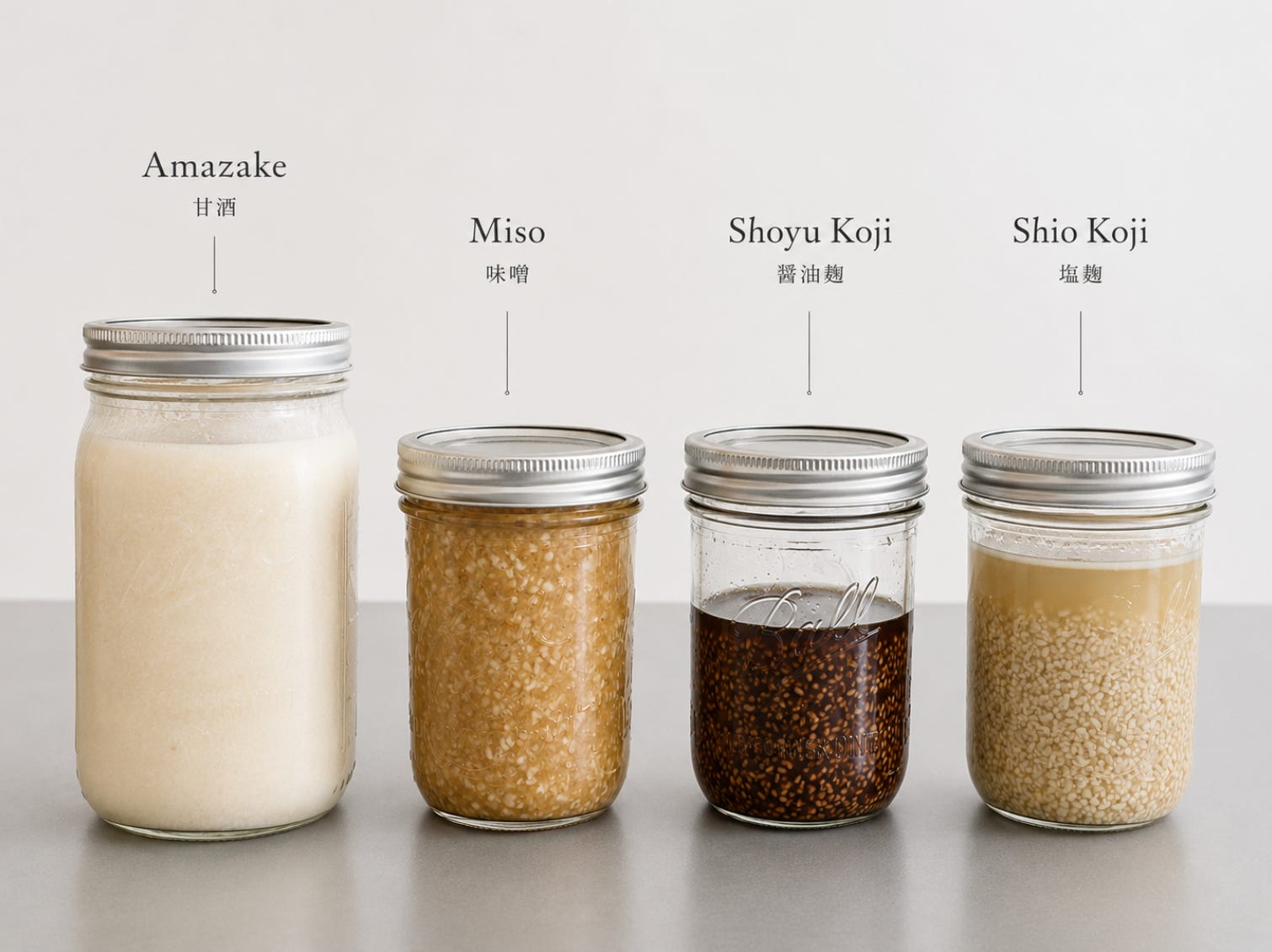
⊹ 01 — Shio Koji 塩麹 |salt and koji rice
A simple mixture of koji rice, salt, and water, fermented for about a week. What it does to proteins is almost unreasonable: meat becomes tender, fish loses any trace of fishiness, vegetables take on a depth that has no business coming from something so simple. Think of it as a marinade that also happens to be alive. It's the one I always recommend first.
⊹ 02 — Shoyu Koji 醤油麹 | soy sauce and koji rice
Koji fermented in soy sauce rather than salt. The result is thicker, richer, and more complex than either ingredient alone — umami in concentrated form.
One thing I love about shoyu koji: it’s noticeably mellower than straight soy sauce. That softer edge makes it ideal as a finishing seasoning — added at the very end of cooking, in place of regular soy sauce, it rounds out a dish with depth and a gentle, lingering richness that soy sauce alone can’t quite give you.
Once you have a jar in the fridge, you’ll find yourself reaching for it constantly.
⊹ 03 — Miso 味噌 | fermented grain / bean paste
The one most people already know — and the one most people underestimate. Miso is so much more than soup. It’s a seasoning, a marinade, a glaze, a depth-giver. A Michelin-starred chef once said something that stayed with me:
“Whenever something tastes like it’s missing a layer — I add miso.”
That’s exactly it. Miso is the ultimate finishing condiment. It doesn’t announce itself; it simply makes everything taste more like itself.
Store-bought miso is fine. Homemade miso is another thing entirely — slower, more personal, shaped by the temperature of your kitchen and the particular koji you use. We’ll go deep on this one in a future issue.
⊹ 04 — Amazake 甘酒 | fermented rice drink
Traditionally drunk on cold winter mornings, amazake is made from rice fermented with koji until naturally sweet — no added sugar. Warm, it’s gentle and deeply comforting. But honestly, I keep a jar in the fridge year-round.
On days when you're craving something sweet, a small cold glass of amazake is just perfect — naturally sweet, with nothing added. Blend it into a smoothie, stir it into a dressing, use it to sweeten a sauce. The body recognizes it as something real.
You don’t need to start with all four. You don’t need special equipment, a trip to Japan, or a fermentation-dedicated shelf. You need a jar, some koji rice, salt, and — most importantly — the pleasure of watching something slowly come alive.
⊹ ⊹ ⊹
Start with shio koji. Make a small batch. Use it on chicken or mushrooms once or twice. And listen for it: that moment when your body says yes. When the flavor is so right it feels like something you’ve been missing without knowing it.
This is where it starts. Not just delicious food — a kitchen that changes. A body that notices. A whole world of fermentation — quieter than you'd expect, and better than you can imagine.
I’d love for you to come along.
⊹ ⊹ ⊹
Next week: how to make shio koji at home — the ratios, the timing, and the mistakes worth avoiding.

Ancient Japanese fermentation, made for your modern kitchen. 🌿